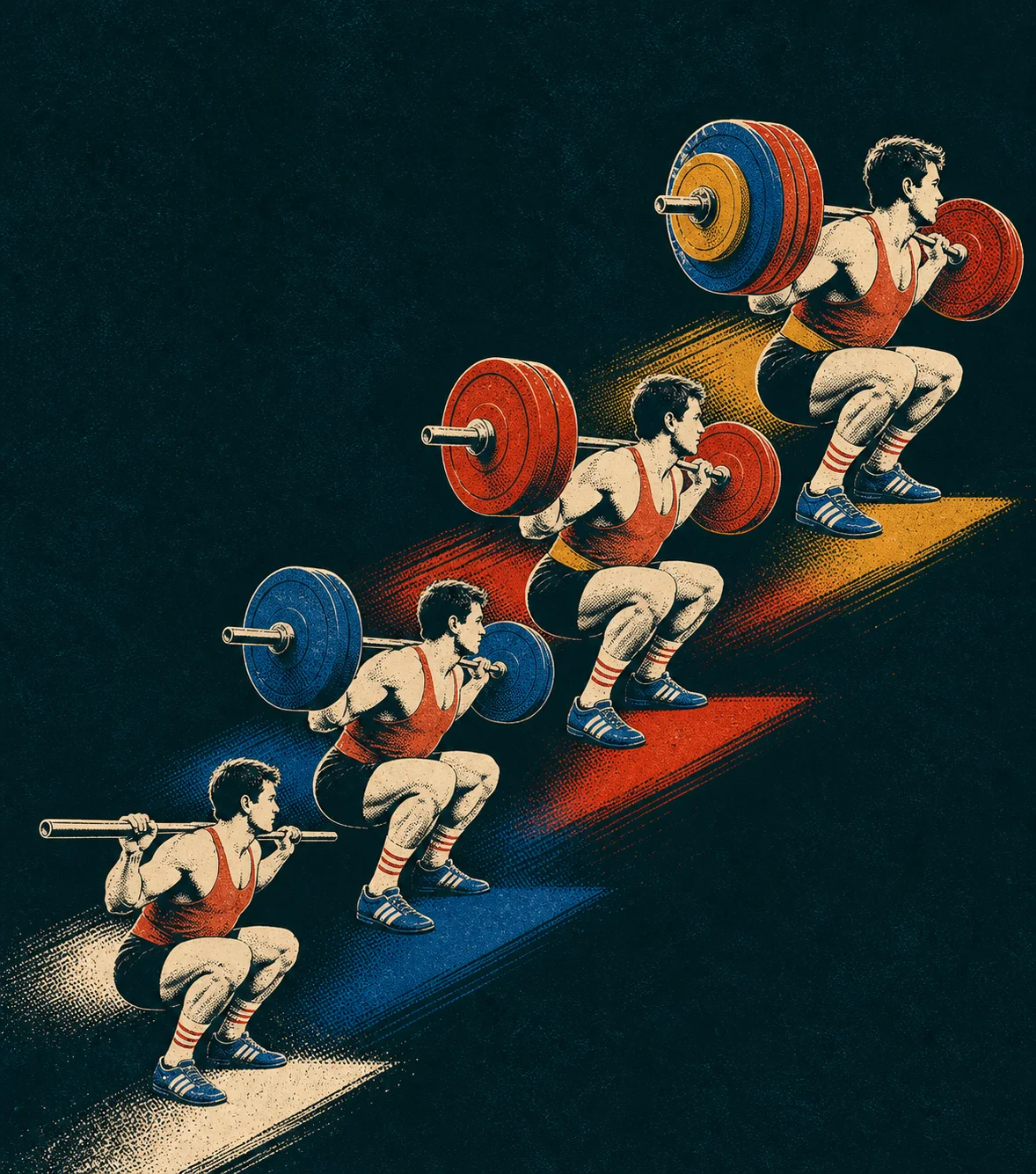
01Warm-up ramp
| Step | % of basis | Reps | Load |
|---|---|---|---|
| Empty bar | — | 8 | 45 |
| Ramp 1 | 40% | 5 | 90 |
| Ramp 2 | 60% | 3 | 135 |
| Ramp 3 | 80% | 1 | 180 |
| Work | 100% | work | 225 |
02Percentage chart
| % of basis | Load (lb) | Typical reps | Zone |
|---|---|---|---|
| 100% | 225 | 1 | Max / test |
| 95% | 215 | 2 | Heavy singles |
| 90% | 205 | 3–4 | Strength |
| 85% | 190 | 4–6 | Strength |
| 80% | 180 | 5–8 | Strength–hyper |
| 75% | 170 | 8–10 | Hypertrophy |
| 70% | 160 | 8–12 | Hypertrophy |
| 65% | 145 | 10–12 | Hypertrophy |
| 60% | 135 | 12–15 | Volume |
| 50% | 115 | 15–20 | Technique / GPP |
| 40% | 90 | 20+ | Warm-up |
03FAQ
How many warm-up sets before a heavy set?
Three loaded ramps after the empty bar: 40% for 5, 60% for 3, 80% for a single. Reps drop as the load climbs so you arrive primed instead of tired.
Should the ramp run off my working weight or my 1RM?
Either — switch the basis above the table. Working weight is simpler day to day; the estimated 1RM basis matches programs written in percentages of max.
Do warm-up sets count as volume?
No. They stop well short of failure, so count only the working sets toward your set target for the muscle.
What do the loads round to?
The nearest 5 lb, and never below the 45 lb bar — every step is a load you can actually build with standard plates.